Sea Level Rise and the Ice Cube Experiment
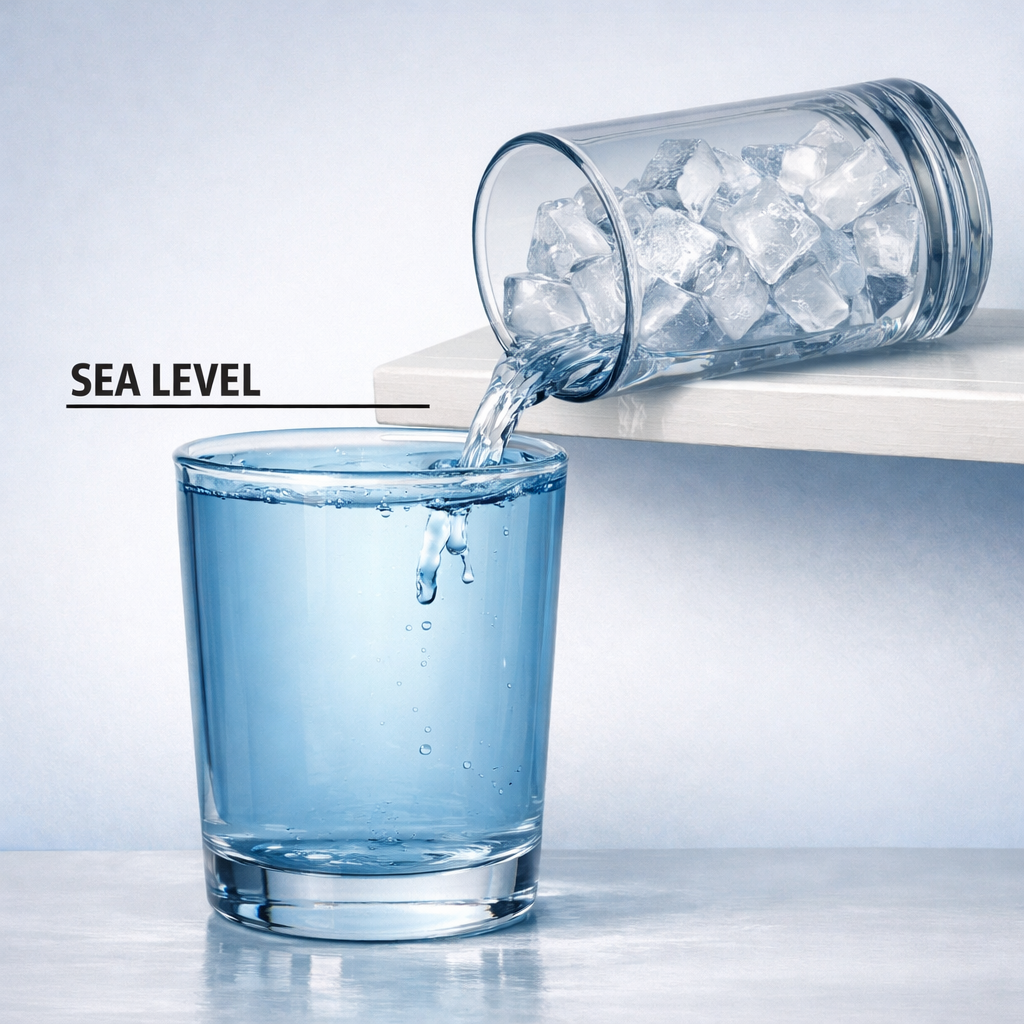
The “Melting Ice” Gotcha
If you’ve ever discussed climate change with a skeptic, you may have been told to try a simple experiment:
Put ice cubes in a glass of water and watch what happens when the ice melts.
When the ice melts and the glass does not overflow, the conclusion is presented as a “gotcha”:
“If melting ice doesn’t raise the water level in the glass, melting ice won’t raise sea levels either.”
At first glance, it seems logical.
It’s also misleading.
What The Glass Experiment Actually Shows
The classic version of the experiment looks like this:
- Fill a glass with water.
- Add ice cubes so they float.
- Wait for the ice to melt.
- Observe that the water level stays the same.
This works because of a basic principle of physics:
Floating ice already displaces its own weight in water.
When floating ice melts, it simply becomes the water it was already displacing. The water level doesn’t change.
That part is correct.
The Critical Mistake: Floating Ice ≠ Grounded Ice
Here’s what the “gotcha” experiment leaves out:
Most of the ice that matters for sea-level rise is not already floating.
There are two very different types of ice:
1. Floating Ice (Sea Ice)
- Already in the ocean
- Already displacing water
- Melting does not significantly raise sea level
Examples: Arctic sea ice, floating ice shelves.
2. Grounded Ice (Land Ice)
- Sitting on land
- Not displacing ocean water
- When it melts, it adds new water to the ocean
Examples: the massive ice sheets covering Antarctica and Greenland.
This is the ice that drives sea-level rise.
How Much Ice Are We Talking About?
The grounded ice sheets are enormous.
- Parts of Antarctica’s ice sheet rise over 50 meters (160 feet) above sea level.
- The total thickness of Antarctic ice ranges from 1.5 to 2 miles thick (about 2,400–3,200 meters).
- Antarctica alone holds roughly 60–70% of Earth’s freshwater.
If all land-based ice in Greenland and Antarctica melted, global sea level would rise by roughly 60 meters (about 200 feet).
That’s not theoretical glass physics — that’s measured ice volume.
When grounded ice melts, it flows downhill into the ocean. That water was not previously displacing ocean water. It’s like turning on a faucet over a full glass: once you add new water, the level must rise.
A More Accurate Demonstration
If you want a household experiment that better represents reality, try this instead:
Step 1
- Fill a glass to the brim with water.
- This represents today’s ocean.
- The rim represents present-day sea level.
Step 2
- Take a second glass filled with ice.
- Place it on its side on a shelf above the first glass so that meltwater can run into it.
Now wait.
As the ice melts, water flows into the full glass — and it overflows. This better models grounded land ice melting into the ocean.
Floating ice isn’t the problem.
Land ice is.
Why This Matters
Sea-level rise is not hypothetical — it is already being measured globally.
Low-lying island nations such as:
are already experiencing coastal flooding, saltwater intrusion, and land loss.
A 60-meter rise would permanently redraw global coastlines. Large portions of coastal cities, farmland, and infrastructure would be underwater. Hundreds of millions of people live below 200 feet in elevation. Displacement on that scale would be historically unprecedented.
Key Takeaways
- The melting-ice-in-a-glass experiment is based on floating ice.
- Most sea-level rise comes from melting land-based (grounded) ice.
- Grounded ice adds new water to the ocean.
- Antarctica and Greenland contain enough land ice to raise sea levels dramatically.
- Sea-level rise is already occurring
The “gotcha” experiment isn’t clever — it’s incomplete.
No Comments
Add Comment